Words are powerful.
In the Judeo-Christian creation story, Creator speaks creation into existence and declares it good, not perfect (see Genesis 1–2).
When I was in early elementary school, I experienced a pressure to be perfect. I now better understand how destructive perfectionism can be. Perfectionism distorts our identity — rooting our identity in looking and acting perfectly. Author Amy Julia Becker provided a helpful visual for how we construct our identity during the Covenant Midwinter Conference for clergy.

When our identity is constructed from our abilities and appearance, it leads to comparison — judging others as less than us or feeling jealous of those who seem superior. It pulls people apart rather than bringing them together. I am deeply aware that our identity is constructed in childhood and of the gravitational cultural pull to understand who we are through what we do and others’ assessment of us.
I’ve told my kids, Theo and Grace, my early elementary story of being called the “r” word on the playground by classmates. I can still picture the girls lining up along the chain-link fence calling me that word. I felt frozen when they said it. I could not access my voice to say, “Stop.” I could not access my agency to tell my teacher or my parents about the label or the pain it caused. Instead, I internalized it. My identity was shaped by the girls’ declaration that I was not good enough. It began my quest for perfectionism in how I performed — a quest made harder with a “learning disability.” This self-limiting belief led to shame and a desire to hide my “imperfections.”
I tell this story to our kids to reflect on the power of words — ours, others’, and God’s. I pair this story with my own journey of receiving my identity as God’s beloved child, made good by God, and invite them to do the same. This is transforming work, since we live in a culture that often defines differences as not good — as defective. This was the distorted view I carried and had to confront when having two children with differences, one who is medically complex and another who has a significant speech difference.
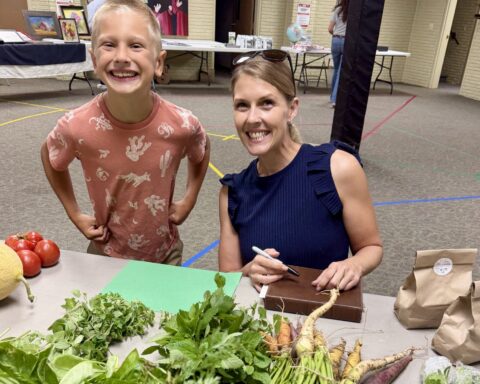
Elevating a good theology of our inherent goodness (Psalm 139) was one of my longings in beginning Food, Fun & Faith, a community that centers the different needs of elementary-aged children and their families — to belong, believe, and be strengthened to follow Jesus together. I believe for those of us with differences, we need to create space to discover the good gifts in ourselves and one another so that we will use our gifts to seek the good of our neighbors.
I have a vision for this group to be a place where unmasking takes place as a result of recognizing one another as God’s good gifts. My prayer for this community is to discover the impact of living out faith in the school and neighborhood, showing up fully as who God made us to be, without needing to blend in or feel ashamed. I believe there is strength in community and one way we image God is with our words — coming alongside one another with compassion in hardship and celebrating one another’s contributions and efforts.
MWC Fresh Expressions of Church
Food, Fun & Faith is part of the Midwest Conference’s Fresh Expressions of Church pipeline, a church planting initiative that encourages leaders to start small and listen deeply to their communities. Through coaching, shared learning, and modest funding, leaders experiment with simple gatherings as they discern how the Spirit may be inviting them to grow new expressions of church.